
 Chronicles
From the MyRSF.net archives of the Email Chronicles
March RSFA Board After Action Report & More AI
Author: Phil Trubey
Date: March 14, 2026
Hello, Phil Trubey here, sending an occasional email about RSF. Yesterday's RSFA Board meeting was very interesting and consequential.
Silvergate
On Tuesday, the Art Jury voted to pass the Silvergate project onto Plan Review, which means they approve the site layout and bulk/mass. The next Art Jury meeting(s) about Silvergate will be for architectural review, landscaping and lighting. Last year's Art Jury already gave significant architectural review comments, which the applicant incorporated into the design seen on Tuesday.
Click here to listen to an NBC 7 news story about the most recent Art Jury decision.
Art Jury Has An Opening
The Art Jury is arguably as important if not more so than the Association Board. Its decisions stay with us for decades.
If you feel you have the chops to give the Art Jury some expertise and have the time to devote to it, there is another opening. Nominations are being accepted to fill out the remainder of a term for the next 9 months until the end of the year (but you can always self nominate for a full term later). Art Jury self nominations are being accepted until March 20 to get a new Juror seated before the April 6 & 7 Art Jury meetings. Contact the Association at 858-756-1174 for more information.
Gateway Variance
Through the years, various Boards have compiled a set of operating rules, mostly about development, for our community. Unlike the Protective Covenant (our CC&Rs) which has some squishy subjective rules that the Art Jury must interpret and wrestle with, the Regulatory Code has black and white rigorous rules. No interpretation needed, and the Art Jury normally enforces those rules when they adjudicate projects.
This year's Art Jury decided to recommend to the Board that these rules not be followed on two projects, one is a lot split, which the Board will take up next meeting, and the Gateway project in the village where the gas station currently resides.
The specific variance the Board had trouble with in this meeting was parking spaces as the developer was looking to only provide 41 spaces as opposed to the Code mandated 49 (it's a calculation derived from rules in the Regulatory Code).
Staff said the reason the Art Jury recommended the variance was as a horse trade for the promise of a 4,500 sq ft grocery. The Board was not persuaded since mandating a grocery isn't really possible - the reality is that it is 4,500 sq ft of generic commercial space. While not mentioned at the Board meeting, my $0.02 is that 4,500 sq ft isn't enough for a functioning grocery anyway (Stumps was 10,000 sq ft).
Many Board members also pointed out that the Village has a chronic parking space shortage as is. Skip Atkins also highlighted something we probably have all experienced: Leaving the Post Office going straight, we often run into a big delivery truck supplying Thyme In The Ranch taking up an entire lane. Imagine that on the much busier road around Gateway.
One of the Board members also opined that the need for a grocery has probably come and gone. We've lived without one in the Village for 14 years or so.
In the end the Board voted 7-0 to deny the variance.
The developer now needs to refashion his proposal realizing he can't get away with short changing the Village on parking.
Taking staff's explanation for the Art Jury's variance, this episode could be seen as the Art Jury and Board working together. Granting or not granting a parking variance for the promise of a grocery store really isn't in the Art Jury's purview, it is decidedly a policy question appropriate for the Board. Seen this way, this was the Art Jury appropriately punting a question upstairs and in the process helping the applicant understand a policy question.
Next Board Meeting, Lot Split Variance
On Tuesday, the Art Jury modified the conditions for a lot split variance they initially passed, so it needs to go out for another 28 day comment period. Staff will hopefully again inform us of the reason for the variance, and we'll see what the Board thinks of this one.
Association Sponsored Project Resolution
This is the resolution that AI and I say is illegal and unenforceable. If enacted, the Board would be abrogating a clearly defined process outlined in our CC&Rs, in my opinion.
According to California law (Civil Code §4805), if an HOA has mechanisms to change their CC&Rs, then those mechanisms must be followed. Our CC&Rs (the Protective Covenant) have a very clearly stated way of changing any provision contained therein, and that is via a Member vote. Thus our Board is not allowed to change/abrogate/undermine/overrule the PC by themselves.
In the Board debate about this resolution, many outright lies and non sequiturs were told.
Courtney LeBeau stated that last summer's Art Jury pushback on the Association restaurant remodel was done on a "whim" of the Art Jury, cost the Association $100,000 and had they not done so, the restaurant would be done by now, all of which I challenge.
Joanne Marks says this resolution wouldn't change anything, to which I reply, then why pass it?
David Gamboa kept going back to the cost the Art Jury imposes on projects. To which I reply, yes, its the same with complying with County Building Codes; it costs money. The costs aren't without value, they have resulted in what Rancho is today.
The most fascinating nugget of information occurred when Director Mark Simpson pierced confidentiality of the executive session meeting that morning. According to Simpson, the Board heard our HOA lawyer make the case that this resolution is legal and enforceable and thus on a 4-3 vote, a Board can overrule the PC.
If that is what he truly said, it may be time for us to get a new HOA lawyer. In addition, his past record for protecting the Association from expensive actions isn't unblemished.
My personal view is that our HOA lawyer tends to tell various Boards what they want to hear, rather than restrain them at appropriate times (like this one). This is exactly what you don't want in an HOA lawyer.
Anyway, with all that said, the Board then voted on the resolution. LeBeau made the motion to adopt it, Simpson seconded, and with only Joanne Marks joining them in voting for it, the motion and resolution was defeated, 3-4.
Chapter 42, Critical View Protection
But wait! We aren't done with Board controversy!
Before we begin, as a side note, I did like the way the Board debated these issues in open session. Yes, some of them were clueless, unprepared and half brain dead (I'm mostly joking), but at least they did what they were supposed to do which is debate in the open. And the restless standing room only crowd held their tongues this time.
Background
You know how beach cities like Del Mar have view protection? You can't build a house too tall such that it would block a neighbor's view of the ocean. Rancho doesn't have that. We in fact have the opposite.
When you drive around most of Rancho, you'll notice that you can't see most of the houses. They are hidden behind dense vegetation. This isn't by accident or poor landscape maintenance. It is actually mandated by Art Jury standards. Rancho enforces "critical views" to ensure privacy between neighbors and the streets.
Poorly Worded Chapter 42
It turns out the Regulatory Code chapter that mandates this, Chapter 42, has a flaw. It states that the Art Jury has continuing jurisdiction over such critical views for all properties that have submitted a landscape plan, as you would if you were doing a major remodel or building a new house. This means that if you chop down vegetation that used to provide critical view obstruction, the Association can ask that you submit a landscape plan to re-enable view blockage.
But what if you've got an older home with no submitted landscape plan? The Regulatory Code is silent.
So as is, we've got a two tier regulation. Newer homes need to maintain their critical views while older and maybe non-compliant ones do not.
Long Gestation
For years, many successive Art Juries and staff have known about this problem. I think during my entire three year term as Board Director, I kept asking when we'd see a Chapter 42 revision. It finally got in front of the Board in January, but was postponed twice to March before we heard the Board debate it.
Anyway, the Board did finally debate it and on a 2-5 vote (only Jeff Simmons and Skip Atkins voting for it), didn't pass the amendment to chapter 42 mostly due to concerns that as written it was too broad.
No One Knows How To Draft Legislation Here
And you know, the majority could even be right. An Art Jury a few years ago had drafted their recommended version, some Board members got hold of it and changed it, and then staff had their go and what came out wasn't great.
Unfortunately, in rejecting the revised Chapter 42, the Board didn't provide any clear policy objectives to staff on how to revise it.
So in the spirit of yet another AI experiment, I asked Claude Opus 4.6 to revise it. I gave it a PDF of just chapter 42 and asked it to create a redline of it with the following instructions. I do not know if this is the policy the Board and Art Jury wants, it's just my best guess. But I suggest that the Board/Art Jury quickly come to consensus of what policy they want, and then have staff/AI redraft Chapter 42.
Instructions for Claude:
Create a new PDF document that is a redline version of the pdf file called 'chapter-42' in this directory with the following changes:
Update the text such that the regulation also enforces Critical View protection and landscape maintenance to properties that have a landscape plan on file with the association and to those that do not.
Ensure the regulation states that Critical View screening of structures in a property must always be maintained. When an owner clear cuts eucalyptus or any trees or the owner stops watering an orchard or any landscaping causing landscaping to not thrive or the landscaping fails to thrive for any reason then they have the responsibility to replace the landscaping or propose a new landscape plan acceptable to the art jury within 60 days of notice by the Association and plant the landscaping within 90 days after landscape plan approval.
The regulation should make clear that if an owner clear cuts or landscaping fails to thrive for any reason then upon a complaint about a Critical View not being maintained, the association will dispatch code enforcement to let them know that within 60 days they will have to submit a landscape plan to replace plant material providing Critical View screening.
Ensure that the document defines Critical View screening which is any landscape plant material located and sized to screen structures onsite from offsite views from roads or neighbors. The art jury can make a determination if screening is a Critical View screening or not.
And here's the redline PDF that Claude AI came up with after a few minutes of thinking.
RSF Fiber Network and Your Home's Wireless Dead Spots
Man, enough of this policy crap, here's something more up my alley.
Race Communications presented a status report of their RSF Fiber Internet network. Interestingly, before the Board meeting, a Member told the presenter that her Internet was awful. It turns out she was referring to her wireless WiFi network in her house.
ISPs like Race, Spectrum, Cox will often give you a wireless WiFi router that provides wireless access to their Internet service within your house. But these single wireless routers really only work for 2 story wood frame construction houses less than 2,000 sq ft. where the wireless signal doesn't have to travel far.
This Member had tried to fix the situation with a couple of cheap signal boosters, which is almost always a bad idea.
Our large and spread out Rancho homes (especially if made of adobe!) demand a much more complex and custom solution to give you high speed wireless Internet everywhere in your home and yard. I personally have 14 wired access points to cover my 7 acres, guest house and basement, but I'm a bit extreme.
Anyway, if you are suffering from poor wireless Internet in parts of your house, it almost certainly isn't due to the fiber connection, it has to do with your wireless access point configuration.
Race has technicians that can come to your house, go into every place you want stellar wireless Internet access with a test device, and configure a system that works. If you're a Race customer, give them a call at 877-722-3833, or visit their Help Center. If you aren't a Race Customer or want help from different consultants, my page here gives a bunch of other options.
Status Update
Race was proud to state that since their first RSF customer went live in 2019, they've only had a single 2 hour outage (in 2019) due to brand new equipment that died suddenly. Since then, zero system outages, which is very, very remarkable.
And as a person who uses the Internet constantly (and have kids who do too), I can also personally attest to this.
They are currently servicing 1,267 residential customers and 50 business customers, resulting in a 62% penetration rate. These numbers haven't changed much during the past year.
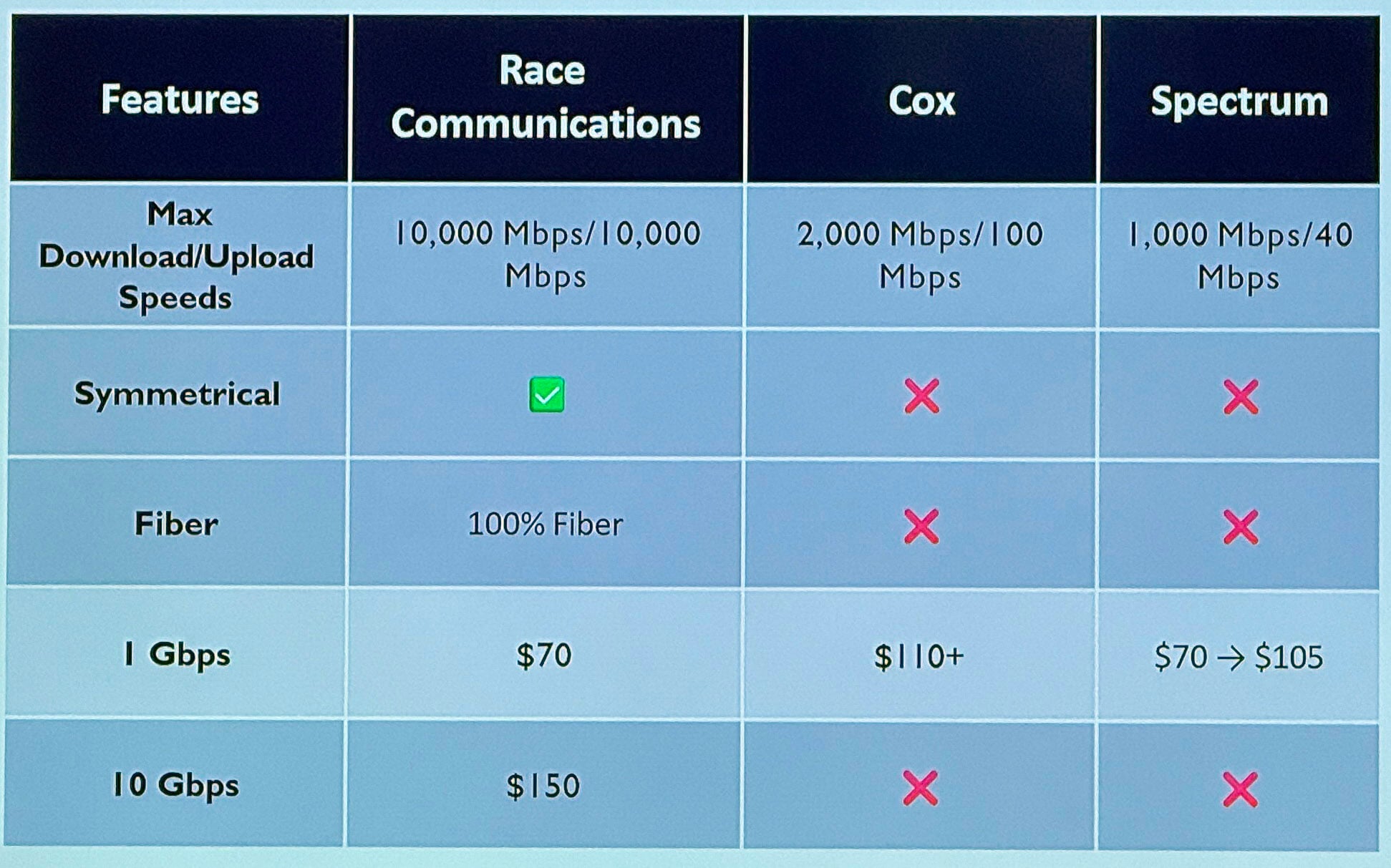
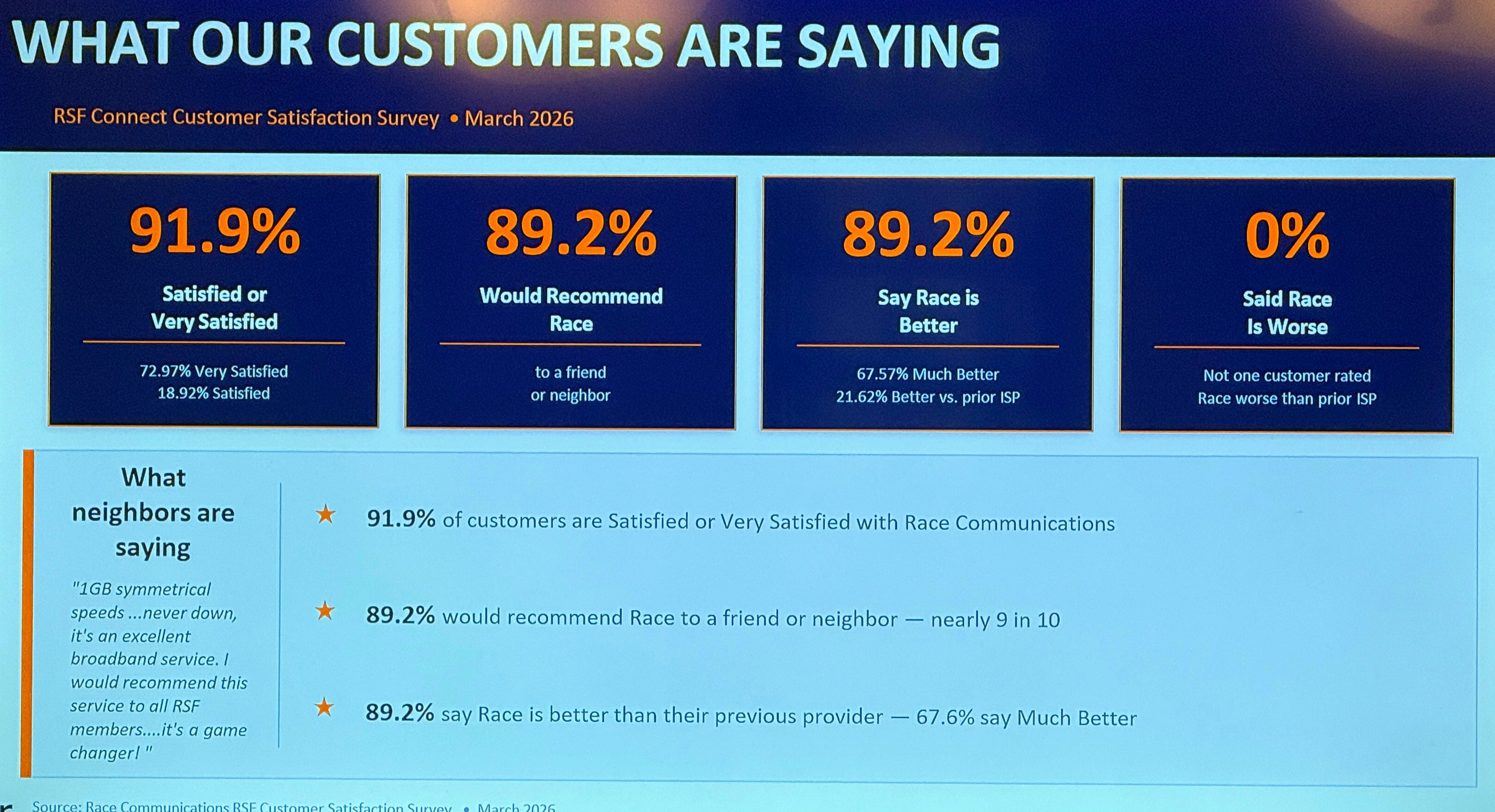
If you were considering changing your ISP to the all fiber Race network, they provided these charts:
Previous emails, Rancho information, poll results, and the old RSF Post archives available at myrsf.net. If you aren't on my email list and want to receive my occasional scribblings, go to this web page and click on the "click here to subscribe" link after the preamble. To unsubscribe, click the link below.