
 Chronicles
From the MyRSF.net archives of the Email Chronicles
RSFA April Board After Action Report
Author: Phil Trubey
Date: April 3, 2026
Hello, Phil Trubey here, sending an occasional email about RSF.
Apologies Back and Forth
The April RSFA Board meeting started off with Board President David Gamboa apologizing for not letting Members attending a recent Board meeting via Zoom give member input. He assured us that he would be mindful of member input, Zoom or otherwise, going forward.
And I'd like to apologize to the golf club since I made two inaccurate statements regarding them in my last email.
First, the golf club did not hire the arborist to give an opinion on tree health, it was the Association's own arborist consultant. And similarly, they did not author the "REQUEST FOR RECONSIDERATION: EUCALYPTUS TREE REMOVAL" one page document. That was prepared by the Association's construction project manager in their role as project manager for all major Association projects (which right now is the restaurant and snack bar).
Golf Course Requests Sail Through
Speaking of which, the Board unanimously approved the removal of both mature eucalyptus trees near the snack bar on the golf course.
I still personally think they were worth saving. But then I didn't agree with the removal of the tall eucalyptus trees behind the 11th green, nor many of the tree removals during the major course renovation five years ago.
Yes, the trees pose potential hazards, but so does driving your car.
And the approval for the kinda ugly and cheap shade sails for the golf maintenance yard was left on consent agenda, so that sailed through unanimously as well. Scroll down this RSF Post article to see a rendering of it.
Again, personally, I think the golf club should have ponied up more money to build a proper structure like the previous Art Jury asked them to do.
A Vote Split for the Lot Split
A Member with a 4.83 acre lot received a variance recommendation from the Art Jury to split their lot and create two buildable lots of 2.46 and 2.37 acres. They needed a variance since the Regulatory Code specifies a minimum size of 2.86 acres for that property. All variances from the Regulatory Code need to be ratified by the Board, hence this Board action.
I'll summarize the robust Board discussion here.
David Gamboa questioned the "why". He stated that the land owners knew (or should have known) about the 2.86 acre minimum when they bought the house about 10 years ago. The crux in his mind is that the owner is simply trying to maximize property value over and above what the land was entitled to have, and it isn't the Association's responsibility to maximize land value when violating the Regulatory Code. Indeed, he said the Board has competing interests of preserving large properties which is a unique Rancho characteristic.
Skip Atkins echoed this sentiment saying people choose Rancho due to its low housing density. In general, he said variances should be looked at with a very skeptical eye. He said that minor variances, like allowing slightly more grading than allowed due to property topography might make sense, but this was a major change that was being requested.
Courtney Silberberg was persuaded by the Art Jury's conditions, especially the undergrounding of the electrical lines that run alongside the current lot. Others however, pointed out that undergrounding electrical would almost alway be required for any major property redevelopment.
Joanne Marks made the motion to approve the variance to allow the lot split/subdivision, Courtney LeBeau seconded. In an interesting twist, Director Mark Simpson was calling into the meeting, yet wasn't connected during the entire Board discussion on this item and thus Manager Albrecht stated that he couldn't be called back and vote on this item.
The vote tied 3-3 with Silberberg voting with LeBeau and Marks to approve the variance, and Simmons, Gamboa and Atkins voting against.
A tie meant the motion failed.
At the end of the meeting when Director Simpson was back on the phone, he asked if the applicant could resubmit for another variance consideration in the future and was told that they could.
A Step too FAR for Gateway
The Gateway project is an attempt at redeveloping this triangular piece of land that includes the village gas station.
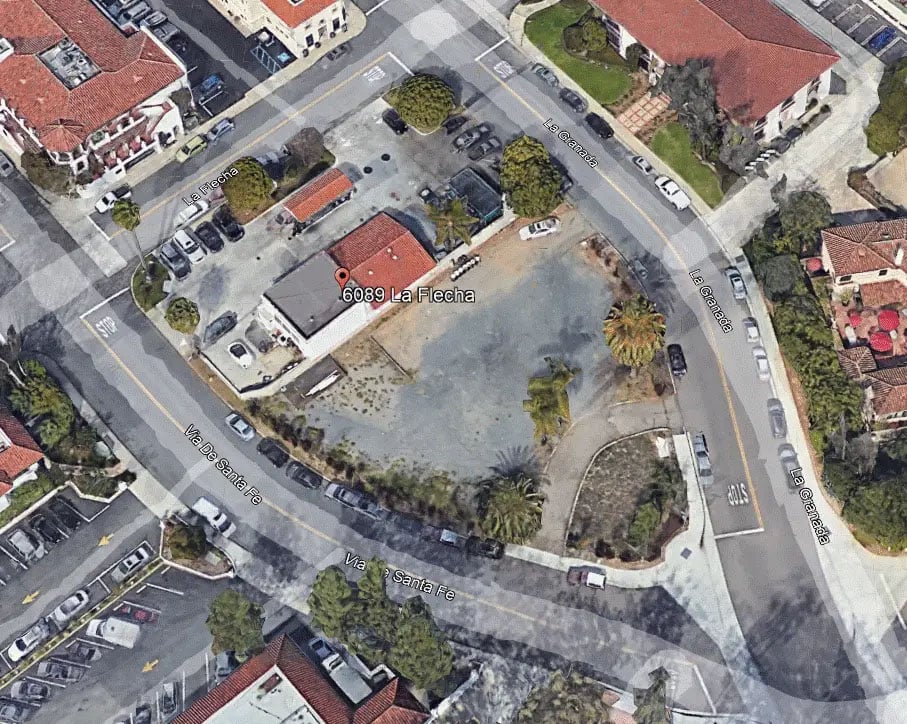
The Gateway is now a generic term for a series of proposed redevelopment projects for this property. The original plan proposed in 2016 was for an office building with a 5,000 sq ft grocery store. After the office building market died post Covid, another plan was proposed for a memory care facility in 2023.
This latest incarnation is for an apartment complex with 15 units (11 two bedroom, 4 one bedroom) built with a basement garage and two above ground floors, all connected via an elevator. A proposed 4,500 sq ft. grocery store would be in the half sunk basement (upper windows would daylight since the lot slopes down there).
The reason for rental apartments is that the land owner (who is different from the developer), wants to retain land ownership, thus ownership condos or a land sale is not possible within this constraint.
The Board already unanimously denied a parking lot variance at last month's Board meeting, from the 49 spaces required by the Regulatory Code, down to the 41 that the applicant asked for.
This month they took up a Floor Area Ratio variance that once again the Art Jury recommended (see below for a discussion about that) and the Board had to either ratify or deny.
A Floor Area Ratio (FAR) is a measure of how intensely developed a Commercial Village property is. The Regulatory Code (chapter 47) limits the FAR to 0.6. This proposed two story apartment complex uses a significant portion of the lot and thus the FAR is 0.93. A one story apartment complex would be under the FAR limit - the underground parking and the half sunk proposed grocer was not included in this calculation.
Board President Gamboa once again went back to the "why" for the variance request. He stated that increased economic value for land isn't enough of a reason for the Board to overturn a Regulatory Code rule. He went further to state that he didn't see how this delivers value to the existing membership at large.
Skip Atkins re-iterated his concern from last month that any grocery store still presents a delivery truck problem (there really isn't room for such trucks in the crowded basement parking lot, nor on the street). He went on to say that each variance promotes more and more intensive development. He stated he's worried about the "mansionisation" of the Ranch.
Joanne Marks stated that a 50% FAR increase is a big ask.
Both LeBeau and Simpson stated they weren't ready to opine on this matter and would like more time to study it.
Gamboa, sensing a defeat of the variance, asked the developer if he would like the Board to delay deciding on the variance until if and when the developer could address the Board's concerns. The developer agreed and the Board deferred action.
My Thoughts
It doesn't sound like the Board is at all keen anymore on a grocery store. Maybe someone should tell the developer this since that 4,500 sq ft of commercial space is what dramatically increases parking requirements & problems.
But beyond that, as a matter of policy, do we want 15+ rental apartments in the Village? Maybe we do, but that probably should be debated if this FAR or other variance comes up in the future on this project. If it's desirable that such rental units be provided, then allowing some variances might make sense. But if the Board's sense is that rental units are just meh, then sticking to the Code requirements would be the way to go.
If the developer manages to pencil out a project that requires no variances, then the project will likely be approved, assuming Art Jury architectural conformance.
My off the wall suggestion is for the Association itself to consider ground leasing the entire lot and build new Association offices, which could be built with enough underground parking for the community. I have no idea if that would be financial viable for any of the parties though.
Distracted Board?
These variances are some of the most important things a Board can adjudicate since they can permanently affect parts of the Ranch. So I was a bit surprised/disappointed to hear so many basic questions being asked of staff during the Board discussion. Seemed like very few Board members had properly reviewed the documents.
I know there is an Open Meeting Act prohibiting Board members from getting together to discuss these policy questions en masse unless in an open meeting BUT that doesn't preclude Board members from asking the staff questions prior to the Board meeting.
Board members should be reading and understanding what staff put together and then ask staff questions if anything is unclear before the Board meeting.
The Board went back to executive session after the open session (they had been there early in the morning as well, with HOA lawyer present), so I assume they are dealing with litigation issues. Unfortunately.
This is what happens when Members (and it's usually Members) sue or threaten to sue the Association. Things grind to a halt and Board members just don't have the bandwidth to attend to other important matters.
The Hot Potato Art Jury
Twice now on the Gateway project, the Art Jury has tossed a live grenade, I mean variance decision, to the Board. Why?
I've heard some Art Jurors explain this as a way of streamlining the application process (something the Board has strenuously asked for).
Here's the deal. On complex projects like building a new house, or even worse, a major commercial development project, there are myriad intertwined decisions that must be made.
A developer typically will ask for many things that the Art Jury says no to. And what would normally happen is that the developer would modify some things and hold firm to others until they were 6 meetings in and pretty much through architectural review, and still some major asks are still unresolved, necessitating a complex rejection, mediation and Board adjudication process. Very slow and very expensive for the applicant should they ultimately be rejected.
As the Association Manager said this meeting, the Art Jury forwarded these variance requests to the Board as a favor to the applicant to move the process along. The developer now knows that parking is not something the Board is going to acquiesce on, and they will be skeptical of intense development resulting in a large FAR without a good reason to approve.
This "new" process seems to be working well. The only quibble I have with it is that the Art Jury should be allowed to forward a variance request to the Board without either approving it or denying it. i.e. there should be third option of "we have no opinion, this should be a matter for Board adjudication".
The parking variance is a good example. The Art Jury really didn't have a reason to approve the variance, they just wanted the Board to make the decision since it really was more of a Board level policy question.
I believe such a "no opinion" option is consistent with the Bylaws which just asks that Board consider variances after they "received the written advice of the Rancho Santa Fe Art Jury thereon". Advice is a pretty broad word here.
Roundabout Update
The County gave us an update on Roundabout construction. We are two years away for a 2028 planned construction that will take 6 months to complete for the one at El Camino Del Norte and Del Dios Highway.
The other two roundabouts (at El Montevideo, and Via de la Valle, all three on the same major road) have no identified funding and no start date.
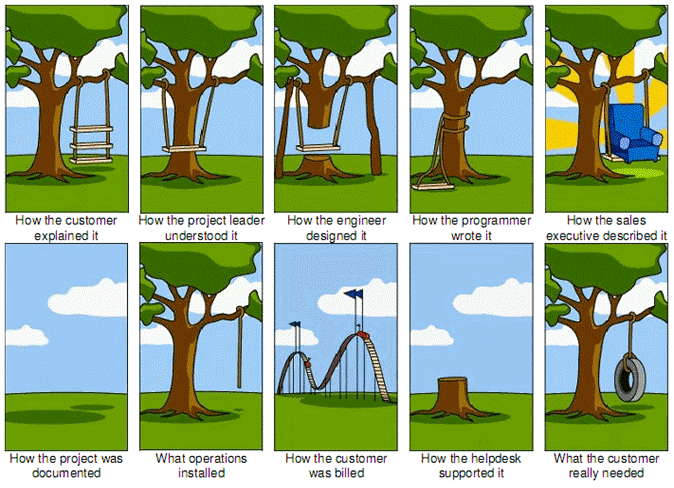
Due to fire department requirements, the beautiful nice original concept has been extensively modified to allow big fire trucks quick access through the roundabouts. See the original concept below and the current design after that.
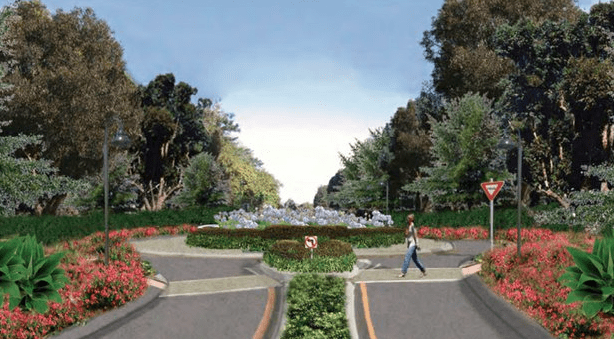
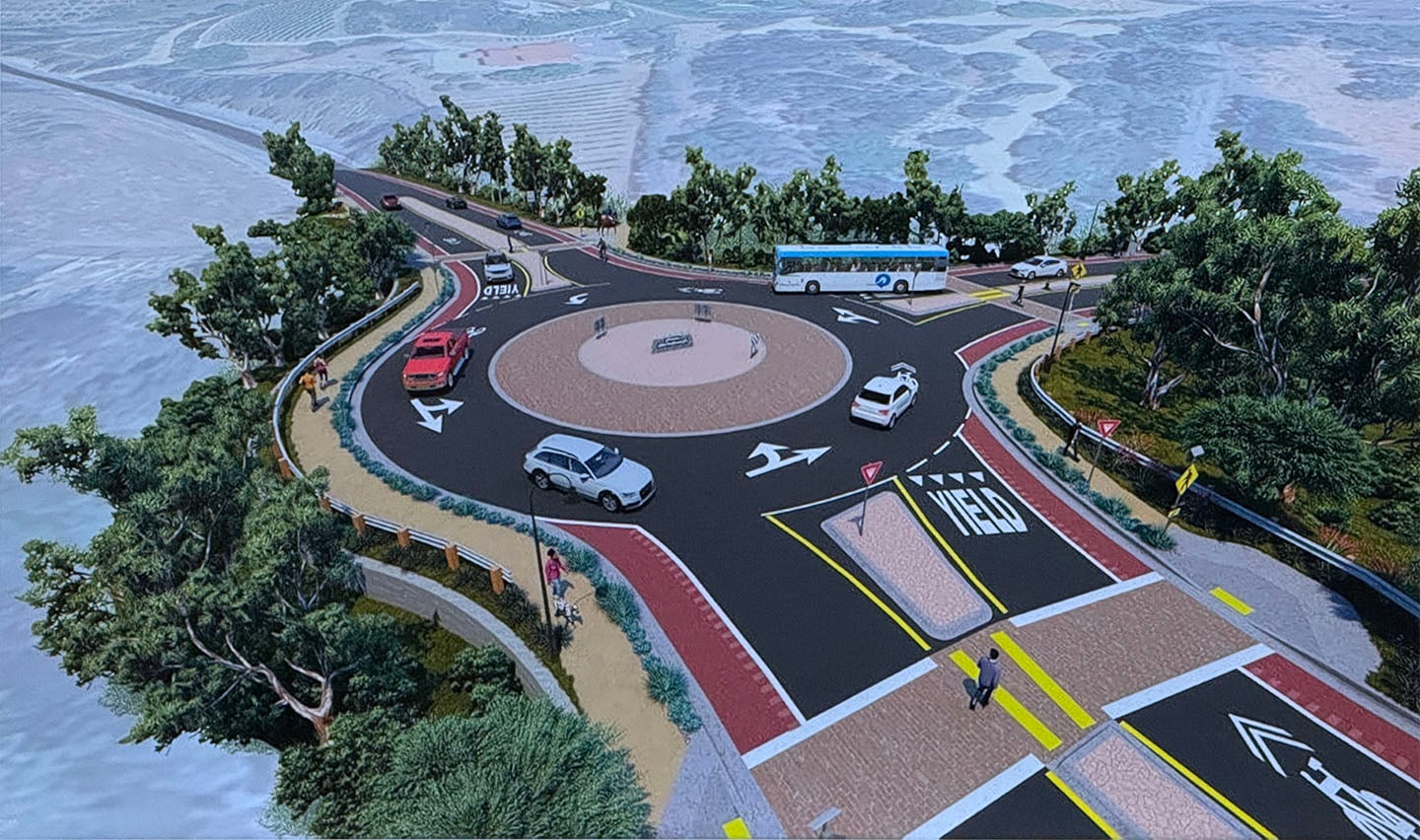
It's a bit of an aesthetic downgrade. Director Simmons once again voiced his displeasure that this is the first roundabout to get constructed since it is the one least needed.
The County gave a bunch of reasons why they chose this one, but it boiled down to it being the easiest, cheapest and quickest. Gotta say that government never disappoints, they'll always do the easiest thing, regardless of what makes sense.
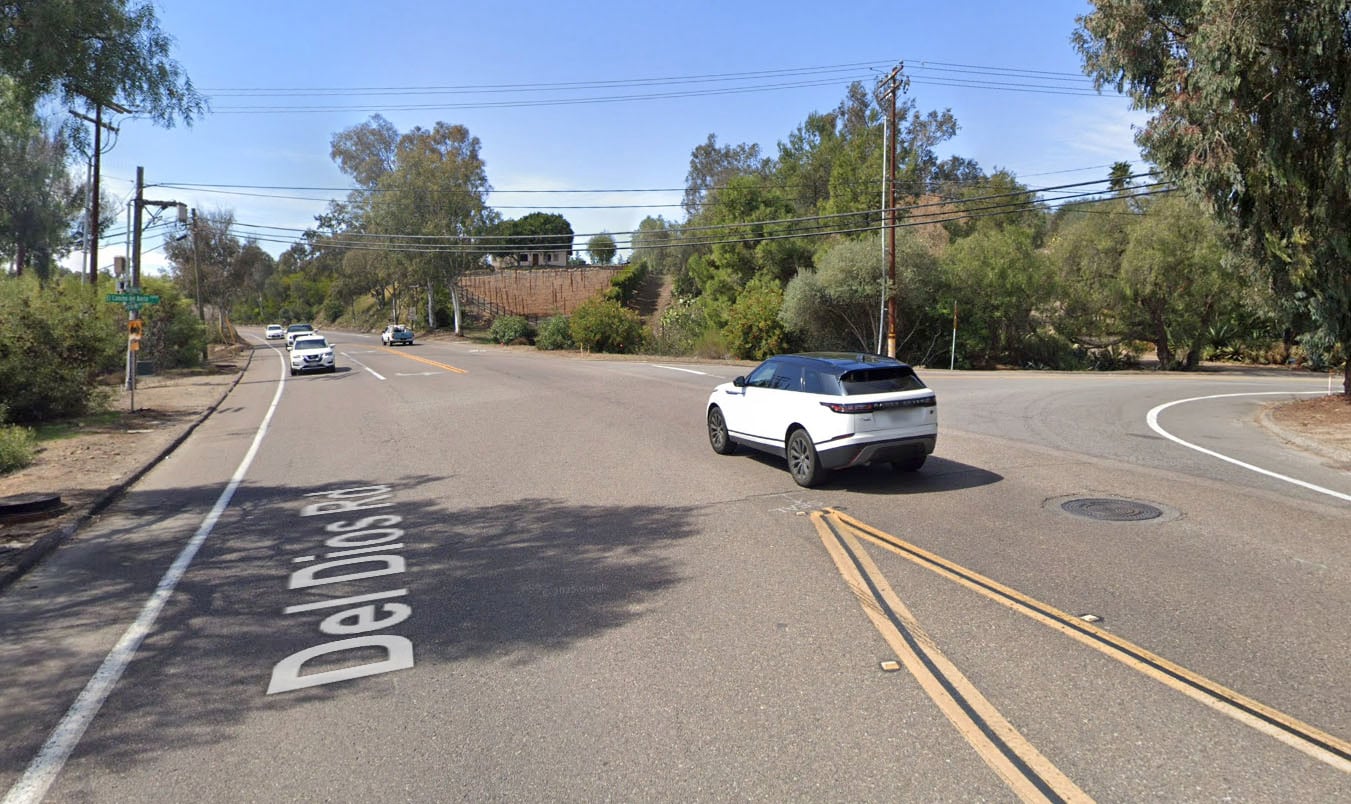
Incidentally, this intersection is blighted by criss crossing telephone and power lines and when asked if the County could ask the utilities to underground these, the response was that the utilities would make that determination. In other words, we'll likely continue having criss crossing telephone and power lines.
Below is what the intersection currently looks like.
At this point, even though I was a proponent of roundabouts over traffic signals, I'm wondering if the larded up, extreme County over design of the roundabouts and thus expense was worth the extra decades of waiting. Then again, the County's current standard for traffic lights is probably also over the top. They sure know how to spend money they don't have.
I'm once again reminded of this graphic.
Preliminary Budget
Association CFO Chris Lake presented an initial pass at the 2026/2027 Association budget. In summary, assessment rates stay unchanged at $0.15/$100 along with modest or non-existent club dues increases.
Previous emails, Rancho information, poll results, and the old RSF Post archives available at myrsf.net. If you aren't on my email list and want to receive my occasional scribblings, go to this web page and click on the "click here to subscribe" link after the preamble. To unsubscribe, click the link below.