
 Chronicles
From the MyRSF.net archives of the Email Chronicles
RSFA Budget & New Law Affecting It
Author: Phil Trubey
Date: August 3, 2026
Hello, Phil Trubey here, sending an occasional email about RSF.
RSFA Assessments' True Cost
First, let me give you a quick primer on how RSFA HOA assessments are done.
Based on our unusual CC&Rs, we assess every property owner a percentage of their property taxes. It's described as $0.15/$100 of assessed property value (latest rate), but since California property taxes are always 1% of assessed property value, our HOA dues are simply 15% of whatever we pay in property taxes.
In other words, while we may complain about HOA assessments, we all pay almost 7 times that amount to California. In fact, if you add up all the other bond surcharges, school taxes, etc., it is well north of 7 times.
Our HOA dues are a much smaller part of the cost of living here than many other factors.
By the way, I just calculated how much in HOA dues I pay for my Big Bear condo. It is 109% of my property taxes. Yep, I pay more in HOA dues there than in property taxes versus the 15% I do here. And that isn't a Prop 13 adjusted property value; it's a recent purchase.
More data: The average California HOA member pays 90% of property taxes in HOA dues as opposed to our 15%.
Quit Whining
Whenever I bring up the possibility of an assessment rate increase, I get a look of horror. From RSFA Board Presidents, to people who pay almost nothing in HOA dues, to people who pay a lot in HOA dues, everyone looks at me like I'm a puppy killer.
An assessment rate increase from 0.15 to 0.16 isn't going to affect your life one tiny bit. The cost of living here far exceeds that tiny extra bit you'd pay in HOA dues.
Of course, Boards should be mindful of wasteful spending, but having seen how the sausage is made for 3 years while on the Board (and Treasurer for two), I can confidently say we run a pretty tight ship. Much better than any municipal government.
Do We Need To Raise Rates?
Maybe. One of the reasons we ended up raising assessment rates from 0.14 to 0.15 a few years ago was that we undertook a huge new construction project: the fiber optic network that gives us all reliable high-speed Internet. This wasn't just maintenance; it was a brand new amenity.
Similarly, our restaurant remodel also isn't purely maintenance. We could have done a much smaller maintenance project but decided to create a much better restaurant.
Going forward, there are other new projects waiting in the wings. The restaurant/golf/tennis parking lot is a shambles. Yes, we could slap asphalt sealer on it and call it a day, but we'd be left with too few parking spaces, dangerous steps, a dangerous undulating third level parking surface, horrible lighting, dangerous and ugly landscaping, giant tree limbs falling on cars, etc. It needs rebuilding from scratch meaning major grading, underground utilities, new light poles, new staircases, new landscaping and it would give us 50 sorely needed new parking spaces. This is going to be expensive but well worth it. And by the way, much of this expense isn't even optional; the County will be mandating a lot of it anyway.
Another project relates to our inefficient and expensive use of two buildings our office staff is spread across, which costs us $25,000 a month in rent for the second office location. We may want to purchase a single location going forward.
And there are other projects people have their eye on too. All of these aren't a waste of money; they absolutely enhance the Association.
In my opinion, the Finance Committee, knowing full well the projected cost of these projects, is tying itself in knots trying to not propose assessment rate increases and instead talking about long term mortgages and the like rather than even consider the obviously simpler and cheaper path of simply raising the assessment rate.
Speaking of which...
We're From The Government and We're Here To Help
In the past, I've mentioned that CA law allows HOA Boards to pass budgets that can increase assessments by up to 20% year on year without a member vote.
I actually did this (raised it 20%) the first year I became Treasurer for my small Big Bear condo association. Assessments hadn't changed for five years prior! Reserves were in the 40% range and we were exposed if anything bad happened, like a big snow year.
So while you probably wouldn't hike rates in consecutive years unless you wanted a rabble outside your front door, it is a valid safety valve for previously mismanaged HOAs.
SB 1007 proposes (it has passed the CA Senate) to cap assessment raises to 8% per year without a member vote.
This is problematic for all HOAs but RSF in particular.
When the RSFA board passes the budget in May every year (July 1st to June 30th fiscal year), they do not know what the percentage assessment increase will be. Since our assessments are a fixed percentage of property value, we do not know what the actual cash assessments will be until the County computes it in the fall and tells us.
In theory, this means we could fall afoul of the law even if the board kept our assessment rate constant.
Actually, not in theory. Take a look at how our assessments have gone up the past several years. Remember that RSFA cash total assessments go up automatically due to assessed property value increasing 2% per year and large property value reassessments that occur upon property sale/purchase.
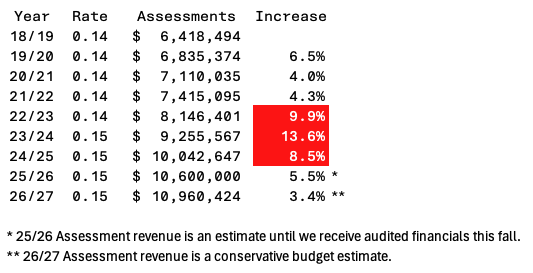
As you can see in red, we had three consecutive years of assessment increases greater than 8%, only one of those years was due to an assessment rate increase.
So what happens in a future year when we keep our rate steady, yet still end up with a more than 8% budget increase? The legally safest thing would be to reduce assessments well after the budget year has started resulting in canceled projects absent mitigations (see below).
This also means that RSFA Boards are very unlikely to propose future rate increases without putting it to a member vote since the chances of such a rate increase pushing us past the 8% ceiling is fairly high.
This would result in a situation where Boards would be even less willing to propose new community enhancements since they would have to mount time-consuming education campaigns, opposed at every turn by activists who wouldn't even want a vote (as I learned firsthand when I tried to push for a vote on Osuna). And then you'd have to wait an extra budget year since all this takes time and it would be hard to squeeze in a vote in the very short time window between when new Boards get going and the budget season.
And this is all likely to hit us starting January 1st.
What Can Be Done?
First, while the Board has set the budget for this fiscal year and has kept the assessment rate steady at 0.15, they could change this in October. Our CC&Rs allow the Board to ratify and change the assessment rate in October if conditions change, as they are likely to this year due to the legislation. This may be the last time the Board can change the assessment rate without a member vote and with our upcoming major projects, I think it would be prudent for the Board to up it to 0.16. They can always reduce it in future years if we find ourselves awash in money.
You can email me your comments now to abuse@myrsf.net where I'll file them in my circular filing cabinet beside my desk 😅. But seriously, I would be interested in hearing feedback, just reply to this email. Remember, considering all the other expenses you have here in RSF, such an increase wouldn't even be noticeable.
There is another legal way out. Current CA law and even under the proposed SB 1007, boards are allowed to enact special assessments during a fiscal year without member vote if it's less than 5% of budgeted expenses. While we only collect about $10M in assessments each year, the RSFA actually has budgeted expenses of around $30M, thanks to golf, tennis, Osuna and other activities we charge for.
Meaning the board can levy up to (for fiscal 26/27) 5% of $31.58M = $1.58M without a Member vote. Which is actually a lot of headroom. The special assessment monies would need to be allocated to a specific project/activity/emergency, but that's quite doable.
Indeed, if the Board found itself on the wrong side of the 8% maximum, it could just vote to set a special assessment for the overage and call it a day. I think. Legal counsel should be consulted 😅.
A much more radical idea would be to reform how we assess our Members. With an admittedly difficult vote requiring a majority of all Members (not just majority of voters, but of all Members), we could change the unique RSFA assessment structure to mirror that of every other HOA in California and simply set a flat monthly fee that everyone pays. This way we would know ahead of time what our yearly HOA budget increase would be and we could hit the 8% limit by design should we need to.
So, there's lots here to chew on. My major concern is that the Association continue to fund upgrades and improvements over the next several years. We are in a Red Queen's race with all our neighboring housing developments and if we don't keep making improvements, all our property values will suffer.
Previous emails, Rancho information, poll results, and the old RSF Post archives available at myrsf.net. If you aren't on my email list and want to receive my occasional scribblings, go to this web page and click on the "click here to subscribe" link after the preamble. To unsubscribe, click the link below.