
 Chronicles
From the MyRSF.net archives of the RSF Post
SFID Proposed Water Rates: What You Can Do Right Now
Author: Marlene King
Date: March 21, 2023
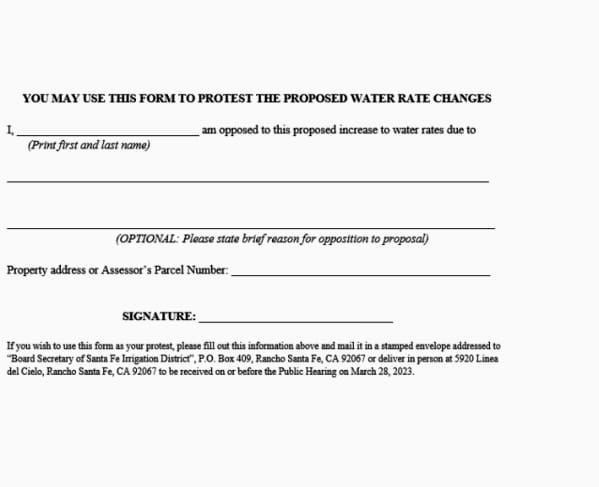
The deadline for submitting Santa Fe Irrigation District (SFID) written protests to proposed water rate increases is in exactly one week’s time on Tuesday, March 28, 2023, by 8:30 a.m. Prop. 218 requires SFID to mail out reasons why increases are necessary, and provides for the public to stop rate increases if 50% +1 customers turn in written protests. It is acknowledged achieving the 50% +1 threshold is exceedingly challenging, considering the higher percentage of city-sized lots in Solana Beach (which the Solana Beach Board majority assiduously subsidizes to keep their rates as low as possible) versus the number of estate-sized lots in 92067. This article is making the case for 92067 customers reframing the SFID rate increase protest.

I suggest customers in 92067, and those in Solana Beach with estate-sized lots, use this written protest period to instead be a communication with SFID that we do not support the way SFID is currently carrying out its duty of conservative infrastructure R&R, rate equity, and careful, fair, conservative planning for upcoming extraordinary expenses for Lake Hodges Dam reconstruction. Rather than focusing on the cognitive domain of facts and figures, this current article focuses on the affective domain, or the attitudes of Board members as they approach rates.
Implicit Bias
How many times have Solana Beach directors said words to the effect that since 92067 customers use so much water on their big lots, they should pay most of the costs of SFID operations. This attitude became pronounced in 2015 when former Gov. Jerry Brown declared a water emergency and SFID forced its customers into allocations, since the 2010 SFID Board had refused to put in place drought rates recommended in its 2010 Cost of Service Study (COSS). The following excerpts from a November 28, 2014, article written by Joe Tash in the Del Mar Times/Solana Beach Sun/RSF Review foreshadows some attitudes:
“Santa Fe general manager Michael Bardin posted a statement on the district’s web site, which said it is ‘not appropriate to compare per capita figures from different water districts, unless such factors as rainfall/temperature, population density, local zoning regulations, community character and socio-economic measures are considered.’
Director Andy Menshek said the state figures point to an inequity in the district’s rates, because residents of Solana Beach use much less water than their counterparts in Rancho Santa Fe, which has larger homes lots and requires more outdoor landscape irrigation. Therefore, he said, those who use less water should not have to pay as large a share of the district’s costs.
Bardin said he has been hearing from customers that they are concerned that rate hikes and water use restrictions will make it difficult for them to maintain their properties, in which they have invested large amounts of money for landscaping.
‘That’s a no-fly zone for this guy,’ said Menshek. ‘To me that’s a very hollow argument.’ ”
There exists a pervasive attitude that owners of city-sized lots are – dare I say it – morally superior to 92067 customers, because their smaller lots cannot possibly require as much outdoor landscape water as lots multiple times their size. And having sat on the SFID board for six years, and listened to another three years of Board meetings, there is, at times, lurking in the background, an implicit bias against 92067 customers, which became more entrenched after the Rancho Santa Fe Association (RSFA) filed suit against SFID over water rates. SFID Board minutes of December 20, 2018, stated the following: “Director Menshek commented that the Rancho Santa Fe residents seem to not want to work collaboratively, and meet a difference of opinion with disrespect, indifference, and entitlement.”
Pervasive Attitudes
File a written rate protest communication to the Solana Beach board majority that customers with estate-sized lots have just as much right to irrigate their landscapes as owners of city-sized lots. Make no mistake, the State of California is taking straight aim at irrigation of lawns not used for recreational purposes, but the State continues to affirm outdoor landscapes appropriate to our climate are permissible to irrigate, regardless of lot size.
The setting of fixed meter charges is a good example of Solana Beach majority attitudes toward rates. COSS consultant discussions during 2015 noted the industry average of fixed meter costs was approximately 30% of total costs to fixed rates. Despite requests from the two 92067 directors, the Solana Beach majority refused to increase the percentage of total revenue to fixed costs. The current COSS consultant presented rate scenarios with 20% and 25% fixed meter costs. However, minutes of the October 25, 2022, Special Board Meeting show the following: “A motion was made by Director Menshek, seconded by Director Friehauf to direct staff to… utilize an 18% fixed charge…” Motion passed 3-2 (Directors Johnson and Westphal voting no.)
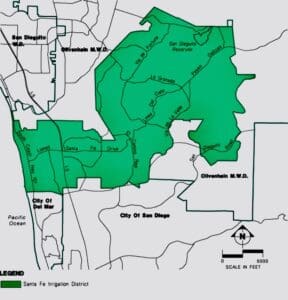
What is vexing about the Solana Beach majority dragging their feet in moving toward the industry standard of 30% fixed costs – especially since other water districts acknowledged that effects of climate change on water resources require a more stable revenue stream derived from fixed costs – is that the majority’s refusal, coupled with looming extraordinary costs for the Lake Hodges Dam replacement, and the lack of local water since the California Dept. of Safety of Dams has imposed a permanent height restriction of 280 ft. until a new dam face is constructed means the Solana Beach majority has essentially tripled-down on their inability/refusal to set rates necessary to run the District without stripping millions of dollars each year from reserves.
Submit a written protest communication to SFID Directors that you do not approve of the long-term negative financial position their subsidy of essentially Solana Beach city-sized lots has created for SFID.
Love/Love Relationship
Water rates for predominately Solana Beach customers with city-sized lots demonstrate a Solana Beach board majority love/love relationship with those customers: As SFID recently bragged, they have the lowest rates in San Diego County! By contrast, the board majority relationship with 92067 customers trends more along lines of tolerate/barely tolerate. Prior to the adoption of rates in 2016, both 92067 directors’ suggestions and concerns were routinely ignored. A Solana Beach director flat out questioned what was wrong with me since I studied the COSS document. Attitudes turned a tad cranky when RSFA filed suit over those rates. The SFID minutes from the September 10, 2019, Special Board meeting on rates stated the following under Directors’ Comments:
“Director King reported she was ‘blind copied’ on email Director Menshek had sent to the Solana Beach City Council and expressed concern that his comments were not factually supported, specifically his comments that Solana Beach customers’ water rates would double or triple and that the Rancho Santa Fe Association has spent a lot of money to influence the SFID Board. She took exception that it represented that any Director’s vote could be bought, and expressed disappointment that the RSFA did spend resources to request multiple alternatives be presented, and appreciated that Carollo presented five alternatives because the RSFA’s multiple requests back in 2016 were not explored. Director King added that she felt it was unfortunate this email was sent to elected officials representing the largest area of the District.”
Regrettably these minutes point to underlying attitudes of conflict and suspicion between 92067 and Solana Beach rate payers. Other water districts are more successful at establishing rates more accepted by their general customer base. I do believe the fact that SFID provides water service to only two customer bases – Solana Beach and 92067 – creates a challenge. Currently, a five-member board has four directors living in Solana Beach; we’ll know at the March 28, 2023, public hearing how that board vote shakes out.
Future of Rates?
Nearly two years ago the State of California Department of Water Resources (DWR) provided SFID a lot-by-lot analysis of how much outdoor irrigation each lot potentially requires. SFID still has not turned this critically important data over to its customers. G.M. Lau did state long ago that the DWR analysis of total water to be sold is not that far off from SFID’s actual water sales, noting several large horse farms appeared to need a review by DWR. It remains to be seen how the DWR data will affect attitudes on the Board regarding the appropriateness of irrigating one’s outdoor landscape. In voting for the proposed tier rates, Directors Hogan, Menshek and Friehauf all stated their belief that tiered rates promote water conservation. I do not know if data would actually support that belief. Once the 2016 allocations were lifted, SFID management expected water use to bounce back to pre-allocation levels…but it did not. My instinct is if DWR is successful at weaning Californians away from their love affair with green lawns, the argument that tiered rates promote conservation – their defense against uniform rates – may look different.
It will be interesting to see how SFID adapts to the foreseeable future with little or no local water. How will the Solana Beach majority wrestle with rates in the next COSS which needs to be in place by January 1, 2026? Will the Solana Beach majority ensure all repair costs for current Lake Hodges repairs and future Lake Hodges reconstruction costs be divided equally amongst every SFID customer, as all previous COSS local water costs have been determined?
Continue a dialogue with the Solana Beach majority by taking a minute of your time and a stamp to mail your written protest communication. Or, save the cost of a stamp and drop off your written protest communication in person at District offices or in the little payment mailbox.
All written protests must be in the hands of SFID staff by 8:30 a.m., Tuesday, March 28. Please note: SFID requires a “wet signature,” therefore, do not email or fax SFID your written protest. Also, there is no legal obligation to provide a reason for your opposition to the rate proposal other than the words you are opposed to the proposed water rates.